Friendship
Say no without disappearing
Decline tonight without offering time you don't have.
Try this conversation PretakeFree practice
Free practice · No signup
Dishes have been left in the shared sink overnight several times this week. You want a workable agreement, not an argument about who is the tidiest.
Agree on one specific expectation for the shared kitchen.
Scripted examples, not AI predictions. Nothing here is sent to another person.
Read the complete examples below, or enable JavaScript to choose your way through the conversation.
Read the examplesThe dishes, the bins, overnight guests, and noise may all matter, but combining them makes this a much larger conversation. Pick the issue you want to resolve first. Describe what has been happening without turning it into a judgment about your roommate's character.
‘Keep the kitchen clean’ can mean different things. ‘Clear one side of the sink overnight’ is easier to discuss. Try a small agreement with a clear time or action, and ask whether it is realistic for the other person's schedule.
Return to the arrangement you made: ‘We agreed to clear the sink by morning, but it's been full this week. Does that plan need changing?’ This keeps the follow-up connected to something specific. For another shared-home example, the difficult-conversation guide covers overnight guests.
For a different shared-home situation, read the overnight-guests example.
These are original, fictional writing exercises. Neither route guarantees agreement; choose wording that fits your situation.
The reply introduces a practical constraint. You can adjust the plan without losing the original concern.
YouThe sink has been full a few mornings this week. Could we both clear our dishes before bed?
Your roommateI work late. I can't always do everything before bed.
Would clearing them before you leave the next morning work? I need the sink free when I make lunch.
You gave a reason and another specific time. An agreement needs to work for both people.
Could we at least keep one side of the sink clear overnight, then wash everything the next morning?
You reduced the request to a practical starting point. Check that this would actually address your concern.
You can acknowledge your own part without abandoning the need for a shared agreement.
YouCan we work out a kitchen routine? I've been finding the sink full when I need to cook, and I'd like us to agree on what works.
Your roommateI feel like you think I'm the only messy one.
I've left things out too. I'd like a rule we both follow, rather than keeping score. What time should we aim to clear the sink?
You brought the exchange back to a shared action instead of comparing past mistakes.
That isn't what I meant. What feels uneven to you? Then can we agree on a routine for both of us?
You left room to hear their side and kept the practical topic in view.
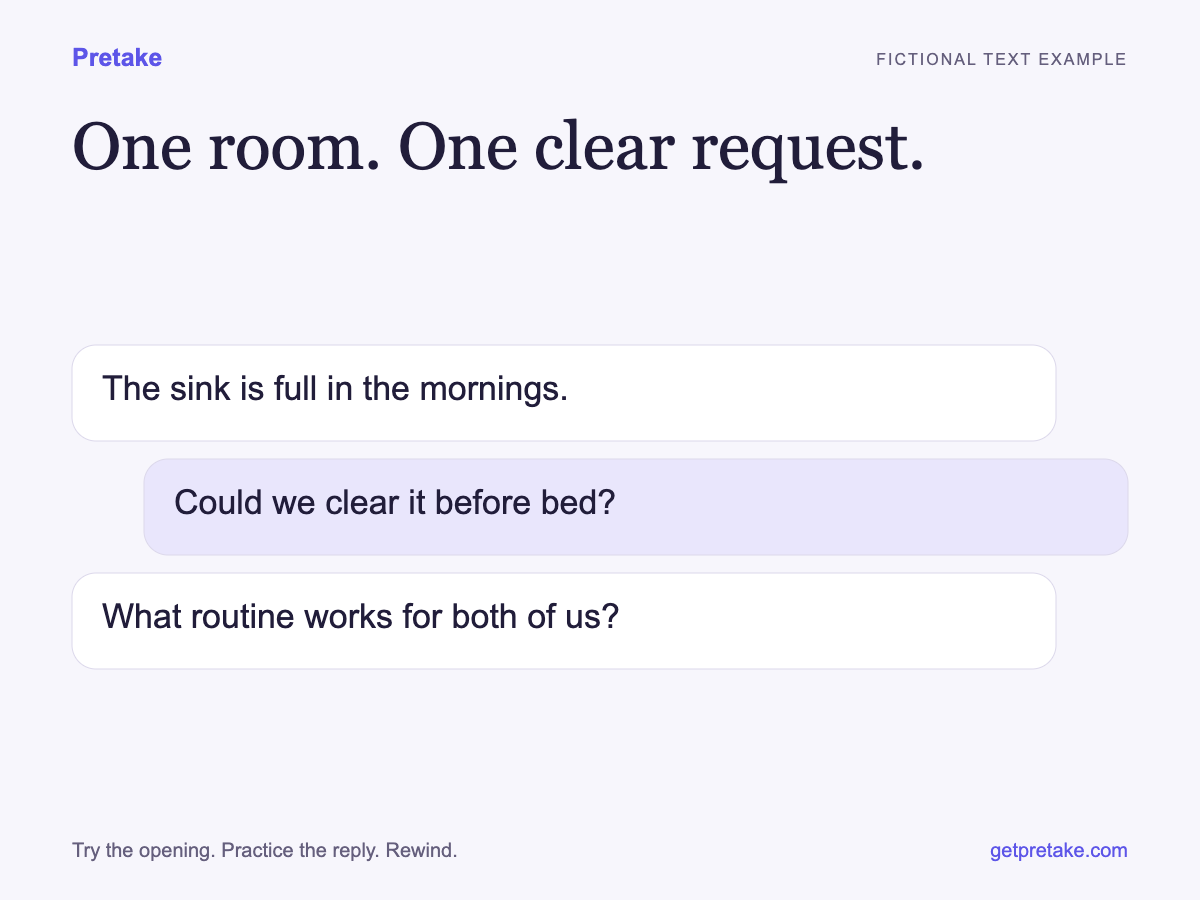
Save the example, or use the blank worksheet to prepare your own opening and follow-up.
Friendship
Decline tonight without offering time you don't have.
Try this conversationApologies
Acknowledge the impact and offer a next step you can keep.
Try this conversationAt work
Make the trade-off visible and agree on the next task.
Try this conversation