Friendship
Say no without disappearing
Decline tonight without offering time you don't have.
Try this conversation PretakeFree practice
Free practice · No signup
You are finishing a report due today. Your manager has added a presentation with the same deadline, and you cannot complete both to the expected standard.
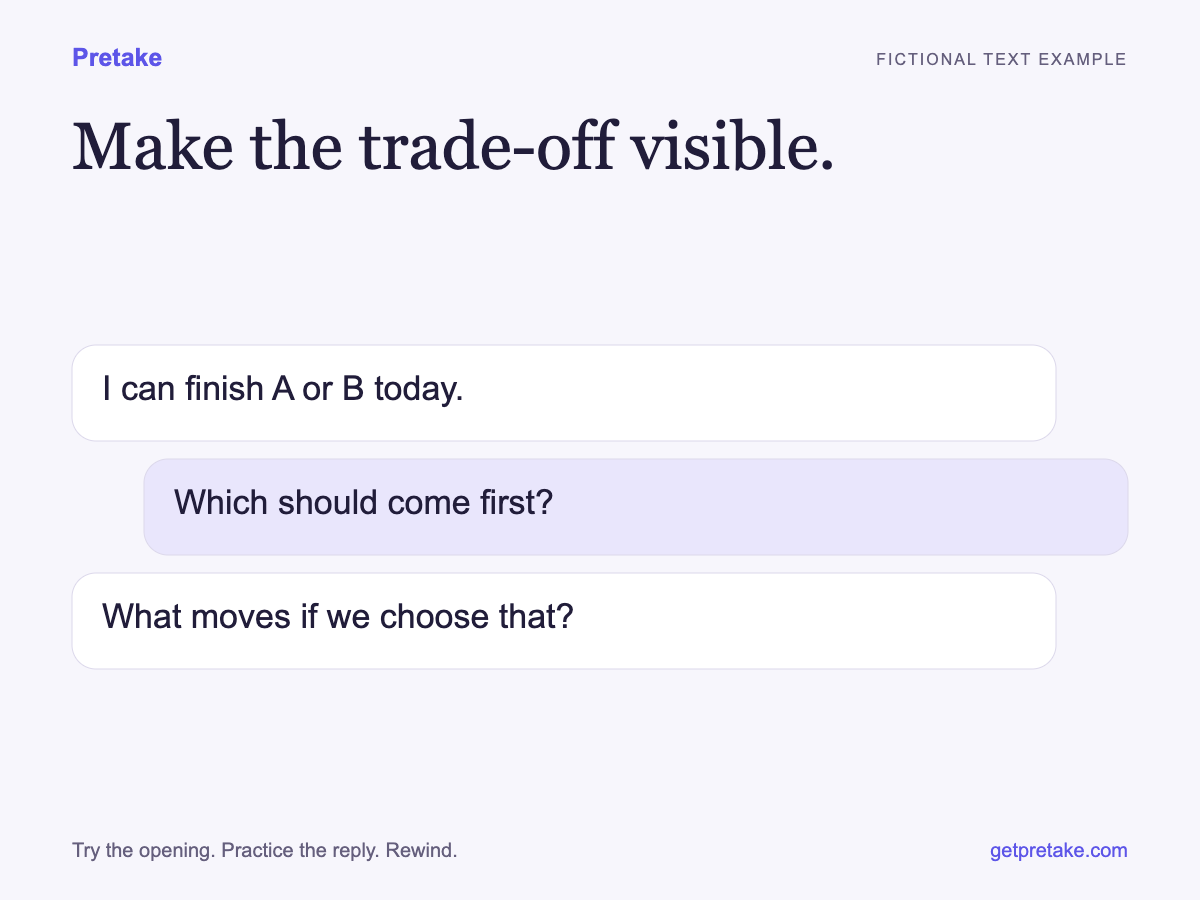
Make the trade-off visible and agree on the next task.
Scripted examples, not AI predictions. Nothing here is sent to another person.
Read the complete examples below, or enable JavaScript to choose your way through the conversation.
Read the examplesName the competing tasks, their deadlines, and the point where they conflict. You do not need a long account of every busy hour. A short description gives your manager something concrete to prioritize.
Avoid offering an impossible option just to sound flexible. A reduced draft, a later deadline, or help from someone else are different choices. Explain what each one changes so the answer can guide your next action.
Once an order is agreed, a brief written recap can clarify what you will do and what moves. For example: ‘I'll finish the slides today; the report follows tomorrow morning.’ This exercise is about wording a work request, not advice about employment rights or a guarantee that a manager will agree.
These are original, fictional writing exercises. Neither route guarantees agreement; choose wording that fits your situation.
You asked for a priority, but the reply didn't resolve the capacity problem. Make the available choices more concrete.
YouI can finish the report or the presentation today at the current scope. Which should I prioritize?
Your managerThey're both urgent. I need both today.
I can finish the report and a rough presentation outline today, or finish the slides and move the report to tomorrow. Which works better?
You turned an abstract overload into two specific options. Use estimates and scope that match your actual work.
To deliver both today, I'll need someone to take the slide formatting. Is there anyone available, or should we reduce the scope?
You named the support needed instead of silently committing to a deadline you cannot meet.
The manager has added information about the priority. Confirm what that means for the other deadline.
YouI suggest finishing the report first because the client needs it today, then sending the slides tomorrow morning. Does that order work?
Your managerThe presentation has to come first for the meeting.
Understood. I'll do the presentation first. Can we move the report deadline to tomorrow so I can plan around that?
You connected the new priority to a specific change instead of leaving both expectations in place.
What does the meeting need from the presentation today? If an outline is enough, I may still have time for the report.
You checked the required deliverable. A smaller scope only helps if it meets the actual need.
Save the example, or use the blank worksheet to prepare your own opening and follow-up.
Friendship
Decline tonight without offering time you don't have.
Try this conversationApologies
Acknowledge the impact and offer a next step you can keep.
Try this conversationAt home
Agree on one specific expectation for the shared kitchen.
Try this conversation